ipv6 cheat sheet
2026-02-14
Personal ipv6 cheat sheet - homelab view
Structure of an ipv6 (from roesen.org)
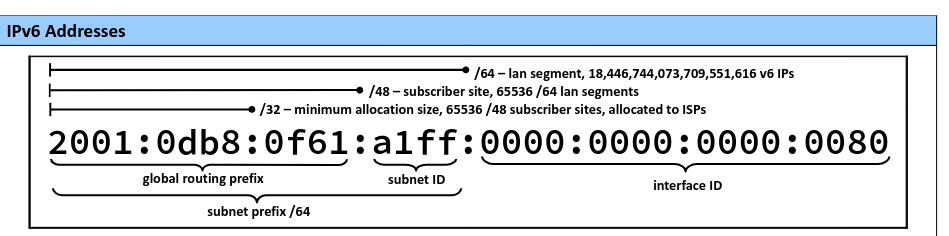
Mappings ipv4 -> ipv6:
| ipv4 | ipv6 | desciption |
|---|---|---|
| 127.0.0.1 | ::1 | localhost |
| 192.168.0.1 | fd00::1 | private addresses |
| 10.0.0.1 | fd00::1 | also private |
| 172.16.0.1 | fd12:3456:789a::1 | private, randomised |
| 224.0.0.0 | ff00:: | multicast scope |
| 255.255.255.255 | ff02::1 | "broadcast", roughly |
New concepts in ipv6:
link local addresses
fe80::/10 - always auto assigned. used for neighbor discovery and others.
global routing prefix
2001::/16 - ISP assigned subnets, address starting with 2001 is usually globally reachable
note: anything in 2000: to 3fff: can be globally routable, 2001: is just common.
multiple addresses
most devices will have BOTH of the above - one link local, and one global address.
stateless address autoconfiguration SLAAC (no DHCP required)
if a client just needs SOME address, ipv6 router advertisement will give one with the configured routing prefix - globally unique.
for privacy, SLAAC can use temporary addresses (otherwise you are very easy to track due to globally unique ipv6).
multicast scopes:
ff02::1 - all nodes on the local link
ff02::2 - all routers on the local link
ff05::2 - all routers in the local site
ff08 organisation-local
shorten addresses:
leading zeroes can be skipped.
blocks of 0000: can be replaced by a ::, as many as needed. example:
localhost is 0000:0000:0000:0000:0000:0000:0000:0001. we write it as ::1
link local addr. is fe80:0000:0000:0000:021a:2bff:fe3c:4d5e (example). write it as:
fe80::021a:2bff:fe3c:4d5e
others (idk much about them)
ipv4-mapped ipv6
::ffff:0:0/96 - example: ::ffff:192.168.1.2
also
64:ff9b::/96 - idk also something about ipv4